XM is known for offering high leverage of up to 1:1000 for eligible clients. This gives traders greater flexibility to control larger positions with a relatively small amount of margin.
However, 1:1000 is not the same as unlimited leverage.
The maximum leverage available to you can depend on your country of residence, XM entity, account conditions, and trading instrument. In addition, margin requirements can vary depending on the product and applicable trading conditions.
For beginners, the most important point is this:
High leverage increases trading flexibility, but it does not automatically increase your chances of making a profit.
This guide explains how XM leverage works, when margin conditions may differ, and how to use leverage as part of a sensible trading strategy.
- XM Leverage at a Glance
- What Is Leverage?
- Why Trade With High Leverage?
- XM Leverage Is Not Unlimited
- Can XM Leverage or Margin Requirements Change?
- Dynamic Leverage and Trading Volume
- How Leverage Should Influence Your Trading Strategy
- How I Use Leverage for Different Instruments
- High Leverage: The Real Advantage and Risk
- What If My XM Balance Becomes Negative?
- What Leverage Should Beginners Choose?
- Frequently Asked Questions About XM Leverage (FAQ)
- How to Open an XM Trading Account
- Final Thoughts: Treat 1:1000 as Flexibility, Not a Target
XM Leverage at a Glance
When comparing XM leverage, looking only at the account type is not enough.
The four most important factors are maximum leverage, trading instrument, account conditions, and trading volume.
| Factor | XM Leverage / Margin Consideration | What It Means |
|---|---|---|
| Maximum leverage | Up to 1:1000 for eligible clients | Maximum available buying power |
| Account & region | Depends on applicable XM entity and local requirements | Not every client necessarily receives the same conditions |
| Trading instrument | Forex, Gold, Indices, Stocks, Crypto, etc. | Margin requirements can differ by instrument |
| Account equity | May affect applicable leverage or margin conditions | Larger accounts can be subject to different requirements |
| Trading volume | Some instruments may use dynamic margin/leverage | Larger positions can require more margin |
| Major market events | Depends on applicable XM service/conditions | Some XM offerings provide Stable Leverage |
XM also allows eligible clients to select a lower leverage level rather than automatically using the maximum available.
So, if your account offers 1:1000, you do not have to trade at 1:1000.
That distinction is particularly important for beginners.
Open an XM Account and Choose the Leverage That Fits Your Strategy
Access flexible leverage and multiple trading instruments through XM, subject to the conditions applicable to your account.
What Is Leverage?
Leverage allows you to control a larger trading position with a smaller amount of margin.
For example, with 1:100 leverage, a $1,000 margin requirement could theoretically support a $100,000 position.
With 1:1000 leverage, the same $1,000 could theoretically support a position worth up to $1,000,000, subject to the applicable margin requirements.
But this does not mean that your $1,000 account has become $1,000,000.
Leverage changes the amount of margin required to open a position.
It does not remove the risk associated with the full position.
How Leverage Affects Profit and Loss
Suppose you open a $100,000 EUR/USD position.
If the market moves 1% in your favor, the position gains approximately $1,000.
If it moves 1% against you, the position loses approximately $1,000.
The important point is that the position size determines the actual exposure.
This is why traders should not judge risk simply by asking whether their account uses 1:100 or 1:1000 leverage.
The more useful question is:
How large is my position compared with my account, and how much am I willing to lose if the trade goes wrong?
Why Trade With High Leverage?
High leverage can be useful for two main reasons.
More Efficient Use of Capital
A higher leverage ratio can reduce the margin required to open a position.
This can leave more Free Margin available in your account.
For example, instead of tying up most of your account balance as margin, you may be able to maintain a smaller margin requirement while keeping additional funds available.
Greater Trading Flexibility
Experienced traders may deliberately maintain access to high leverage while using relatively small Position Sizes.
For example, an account may support 1:1000 leverage, while the trader actually opens only a small 0.01 or 0.05 lot position.
In this case, high leverage provides flexibility rather than automatically increasing risk.
That is the right way to think about leverage.
XM Leverage Is Not Unlimited
This is an important distinction.
XM offers leverage up to 1:1000, but this does not mean that traders have unlimited leverage.
Your available leverage can be affected by:
- The XM entity servicing your account
- Your country or region
- The financial instrument
- Account conditions
- Margin requirements
- Trading volume in applicable products
In addition, different instruments can require different amounts of margin.
For example, you should not assume that the leverage available for a major Forex pair is automatically available for every Stock CFD or Cryptocurrency CFD.
The practical rule is simple:
Always check the leverage and margin specification for the specific account and instrument you intend to trade.
Can XM Leverage or Margin Requirements Change?
This is where XM’s current conditions require some clarification.
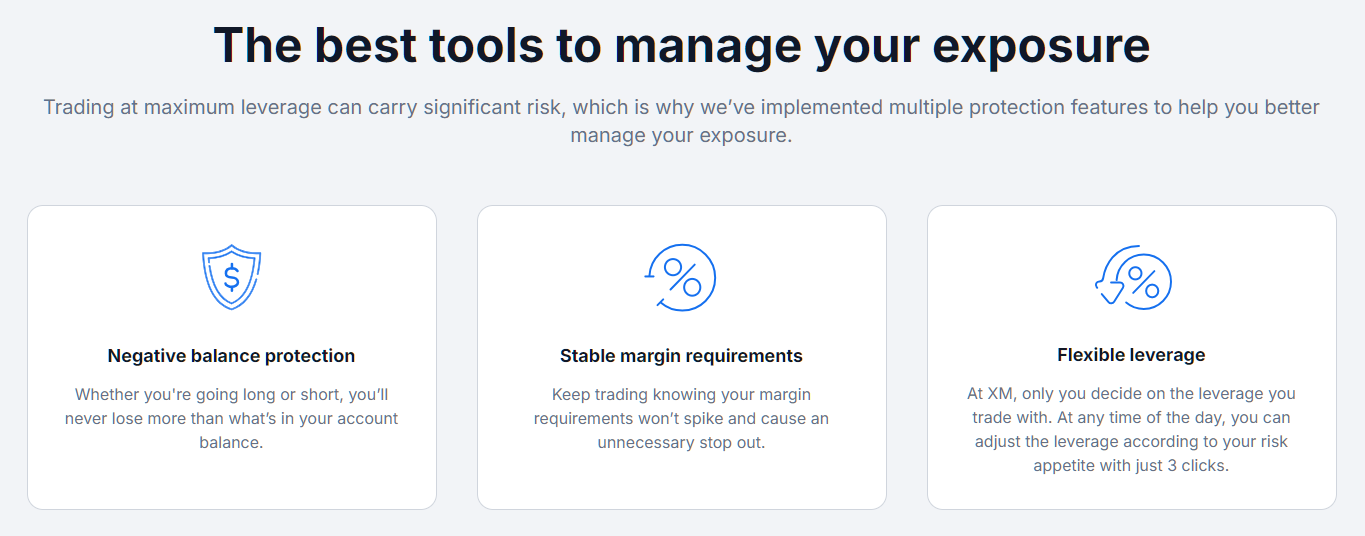
XM currently promotes Stable Leverage, stating that eligible clients can maintain leverage of up to 1:1000 even during high-volatility events and major market news such as NFP. XM specifically contrasts this with brokers that reduce leverage during major news events.
At the same time, XM’s client agreement states that the company may require higher margin in certain circumstances, including market closures, major news announcements and abnormal market conditions, depending on the applicable account and client conditions.
Therefore, the safest way to understand the situation is:
Do not assume that every XM account follows exactly the same margin policy. Check the conditions applicable to your specific XM entity and account.
Important Margin and Leverage Triggers
| Situation | Possible Treatment | What You Should Check |
|---|---|---|
| Higher account equity | Leverage or margin conditions may differ | Applicable account terms |
| Major news release | Stable Leverage may apply to eligible clients | Your XM entity and account |
| Friday/weekend market closure | Higher margin may be required under applicable terms | Current margin conditions |
| Abnormal market conditions | Margin requirements may be adjusted | XM’s latest trading conditions |
| Large trading volume | Dynamic margin may apply to certain instruments | Product-specific specifications |
| Different instruments | Margin requirements vary | Instrument specification |
This distinction is important because “maximum leverage” and “margin requirement” are related, but they are not exactly the same thing.
Dynamic Leverage and Trading Volume
Another factor beginners should understand is dynamic leverage or dynamic margin.
For certain instruments, the margin requirement can increase as your trading volume becomes larger.
In simple terms:
The more exposure you create, the more margin you may need.
This prevents traders from assuming that they can open an unlimited number of lots while maintaining exactly the same margin requirement.
Dynamic margin is particularly relevant when trading volatile products, including certain cryptocurrency CFDs.
Therefore, before opening a large position, check the product-specific margin requirements rather than calculating your required margin from the headline 1:1000 figure alone.
How Leverage Should Influence Your Trading Strategy
The biggest mistake beginners make is asking:
“What is the highest leverage I can use?”
A better question is:
“How much am I willing to risk on this trade?”
My approach is to determine the risk first and leverage second.
My Basic Trading Process
1. Find the trading setup
I first decide whether there is a valid opportunity.
2. Set the Stop Loss
I determine where the trade is considered invalid.
3. Decide the maximum loss
For many trades, I use around 1–2% of account equity as a general risk guideline, although the appropriate level depends on the trader and strategy.
4. Calculate Position Size
I then adjust the lot size so that the potential loss remains within my predetermined risk limit.
5. Check Margin
Finally, I confirm that sufficient Free Margin remains available.
This approach means that leverage becomes a tool for capital efficiency, rather than a reason to increase the size of every trade.
How I Use Leverage for Different Instruments
The same leverage strategy does not work equally well across every market.
Forex
For major pairs such as EUR/USD and USD/JPY, I focus on:
- Controlled Position Size
- Stop Loss
- Risk per trade
- Market liquidity
Even if 1:1000 leverage is available, I do not consider 1:1000 a trading target.
Gold
Gold can experience larger and faster price movements than major currency pairs.
When trading XAU/USD, I pay particular attention to:
- CPI
- Non-Farm Payrolls
- FOMC decisions
- Interest-rate expectations
When volatility rises, I generally reduce my Position Size rather than simply assuming that high leverage makes the trade more attractive.
Indices
For instruments such as US100 and US500, I focus on the overall market trend and volatility.
If I expect a major economic announcement, I reduce my exposure rather than opening a large position simply because sufficient leverage is available.
Stock CFDs
Stock CFDs can experience significant price gaps following earnings announcements or company-specific news.
For this reason, I generally use a more conservative Position Size.
The lower leverage available on some stock CFDs can actually be useful because it naturally limits excessive exposure.
High Leverage: The Real Advantage and Risk
High leverage has one major advantage:
It gives you more flexibility with your available capital.
But the major risk is equally straightforward:
It makes it easier to open a position that is too large for your account.
Consider two traders.
| Trader | Leverage | Risk per Trade | Position |
|---|---|---|---|
| Trader A | 1:1000 | 1% | Controlled |
| Trader B | 1:100 | 20% | Very large |
Trader A uses much higher leverage, but Trader B may be taking far greater actual risk.
Therefore, I focus on:
Position Size + Stop Loss + Risk per Trade
rather than simply choosing the highest leverage.
What If My XM Balance Becomes Negative?
XM provides Negative Balance Protection (NBP) for eligible clients.
In simple terms, NBP is designed to prevent eligible clients from losing more than the funds available in their account as a result of leveraged trading, subject to the applicable terms. XM also highlights Negative Balance Protection as one of its risk-management features.
For a detailed explanation of how NBP works, including examples and conditions, see our dedicated guide:


What Leverage Should Beginners Choose?
There is no single “best” leverage level.
For a beginner, I would prioritize:
- Understanding Margin
- Learning Position Size
- Using Stop Loss
- Limiting risk per trade
- Maintaining sufficient Free Margin
If your account offers 1:1000, you can still trade with a small Position Size.
Therefore, you do not need to lower your available leverage simply because you are a beginner—but you should avoid using the available leverage as a reason to increase your exposure.
Frequently Asked Questions About XM Leverage (FAQ)
Is XM leverage really up to 1:1000?
Yes. XM currently advertises leverage of up to 1:1000 for eligible clients.
Is XM leverage unlimited?
No.
XM offers leverage up to 1:1000 under applicable conditions. It is not unlimited leverage, and the available leverage can depend on the account, entity, region and instrument.
Can I always use 1:1000 leverage?
Not necessarily.
The maximum available leverage depends on the conditions applicable to your account and instrument. You should check the relevant specifications before trading.
Does XM reduce leverage during NFP and major news?
XM currently promotes Stable Leverage for eligible clients, stating that leverage can remain up to 1:1000 during high-volatility events and major market news.
However, XM’s contractual documents also allow higher margin requirements in certain circumstances. The exact treatment depends on the applicable XM entity and account conditions.
Does higher leverage mean higher profit?
No.
Leverage increases buying power and can reduce the margin required for a position. Your actual profit or loss depends primarily on Position Size and price movement.
Can XM margin requirements change?
Yes.
XM’s terms allow margin requirements to vary by instrument and, under certain circumstances, to be increased due to factors such as market closures, major news or abnormal market conditions.
Does XM offer Negative Balance Protection?
Yes, for eligible clients and subject to the applicable terms. NBP is designed to prevent an eligible account from ending up with a negative balance due to leveraged trading.
How to Open an XM Trading Account
If you understand the basic relationship between leverage, margin and Position Size, the next step is to open an XM account and choose trading conditions that fit your strategy.
The general process is:
- Open the XM registration page.
- Enter your personal information.
- Complete the required verification.
- Select your trading account and platform.
- Choose an available leverage level that fits your strategy.
- Fund your account.
- Start with a controlled Position Size.
The exact account options and conditions can vary according to your country and the XM entity serving you.
Ready to Start Trading Forex with XM?
Open an XM account and access leverage of up to 1:1000 for eligible clients, with MT4/MT5 and a wide range of trading instruments.

Final Thoughts: Treat 1:1000 as Flexibility, Not a Target
XM’s leverage of up to 1:1000 can be a major advantage for traders who want greater flexibility in managing their capital.
But the key point is not to use the highest possible leverage.
It is to use leverage without allowing your Position Size to become excessive.
My basic approach is simple:
Decide your acceptable loss → set your Stop Loss → calculate Position Size → check Margin → place the trade.
If you follow this process, high leverage can be a useful tool for capital efficiency rather than a reason to take unnecessary risks.
For traders looking for flexible leverage, multiple instruments and MT4/MT5 trading, XM is worth considering.
Open Your XM Trading Account Today
Access flexible leverage up to 1:1000 for eligible clients and build your trading strategy around disciplined risk management.