For experienced Forex traders, the quality of execution can be just as important as the spread.
A broker may advertise tight spreads, but the real trading cost can be higher if orders are delayed, filled at unfavorable prices, or exposed to significant slippage during volatile markets.
That makes execution speed, latency, liquidity and slippage particularly important for scalpers, day traders, EA users and traders placing larger orders.
Exness emphasizes fast order processing and a technology infrastructure designed to reduce latency and improve execution quality. However, execution is not determined by the broker alone. Your location, connection, account type, instrument, order size and market conditions can all affect the final result.
This guide examines the parts that matter most to experienced traders.
- Exness Execution & Liquidity at a Glance
- Exness Execution Speed: How Many Milliseconds?
- Exness Execution Model: Instant Execution vs Market Execution
- Is Exness NDD, STP, ECN or B-Book?
- Exness Slippage: Can Orders Be Filled at a Worse Price?
- Exness Liquidity: Why It Matters for Real Trading Costs
- Which Exness Account Is Best for Fast Execution?
- Exness for Scalping, EA and High-Volume Trading
- How to Reduce Latency When Trading Exness
- How Should You Test Exness Execution Before Trading Large?
- Exness Execution & Liquidity: Final Verdict
- Frequently Asked Questions (FAQ)
- How fast is Exness execution?
- What is Exness’s average execution speed in milliseconds?
- Does Exness have slippage?
- Does Exness guarantee zero slippage?
- Is Exness an ECN broker?
- Is Exness an NDD broker?
- Is Exness a B-Book broker?
- Which Exness account is best for scalping?
- Is Exness suitable for EA trading?
- What should I check before depositing a large amount?
Exness Execution & Liquidity at a Glance
| Factor | Exness |
|---|---|
| Execution methods | Instant Execution and Market Execution |
| Market Execution | Standard, Raw Spread and Zero accounts |
| Instant Execution | Pro account for many instruments |
| Execution speed | Orders can be processed in milliseconds |
| Latency | Influenced by server location, connection and market conditions |
| Slippage | Possible; not universally guaranteed to be zero |
| Liquidity | Internal pricing and liquidity infrastructure |
| Execution transparency | Public execution information and historical tick data |
| Best suited for | Scalping, day trading, EA and active trading |
Exness Execution Speed: How Many Milliseconds?
One of the most common questions from active traders is simple:
How fast does Exness execute an order?
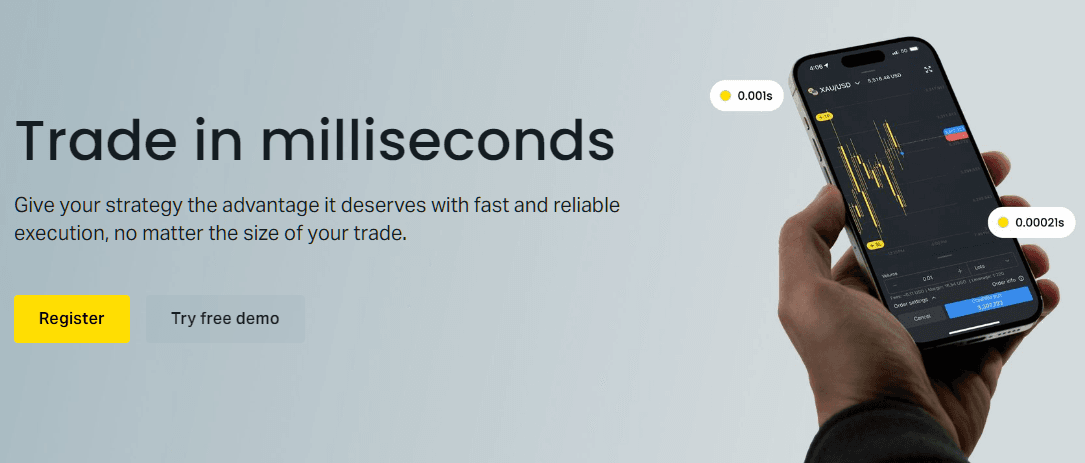
Exness states that orders can be opened, closed and modified in milliseconds. Its trading infrastructure uses a global network of decentralized servers designed to reduce latency.
However, there is an important distinction between order processing speed and your actual trading latency.
Your total latency can include:
- The distance between your device and the trading server
- Internet connection quality
- VPS location
- Trading platform
- Market conditions
- Order size
- Instrument liquidity
As a result, there is no single execution-speed figure that applies to every Exness trader.
What do independent tests show?
Third-party testing has produced different results depending on the account, instrument, server and testing methodology. Some tests have recorded execution times in the tens of milliseconds, while others have reported results above 100 ms.
These figures should be viewed as independent measurements, not guaranteed Exness execution times.
For advanced traders, consistency is more useful than one headline number.
The better question is:
Can Exness consistently execute my strategy at an acceptable latency and slippage level?
That is something traders can evaluate by testing the same instrument, account type and trading session they intend to use with real money.
Exness Execution Model: Instant Execution vs Market Execution
Execution speed cannot be evaluated properly without understanding how the order is executed.
Exness uses both Instant Execution and Market Execution, depending on the account and instrument.
Instant Execution
Instant Execution attempts to execute an order at the requested price.
If the requested price is no longer available within the applicable conditions, a requote can occur.
This model can be useful for traders who place greater importance on price certainty.
Exness says its Instant Execution system is designed to maintain stable pricing and a low requote rate.
Market Execution
Market Execution executes the order at the available market price.
The final execution price can therefore differ from the price displayed when the order was placed.
This is where slippage becomes particularly relevant.
Market Execution can be attractive for active traders because it prioritizes getting the order into the market rather than guaranteeing a specific displayed price.
Is Exness NDD, STP, ECN or B-Book?
This is an important transparency question, but it is also an area where broker reviews often oversimplify.
Exness should not simply be described as a pure ECN or pure NDD broker.
Its documentation describes different execution arrangements depending on the relevant entity, account and transaction. Exness can act as the counterparty to a transaction and may also transmit orders to third parties through Straight Through Processing (STP) in certain circumstances.
Exness also describes itself as a market maker, using its own pricing and liquidity infrastructure.
Therefore, the most accurate description is:
Exness uses a multi-layer execution and liquidity structure rather than fitting neatly into a single ECN, STP, NDD or B-Book label.
What does this mean for traders?
The execution label itself is less important than understanding:
- How prices are generated
- How orders are executed
- Whether the broker can act as counterparty
- How slippage is handled
- What happens during volatile markets
- Whether historical execution data is available
Exness provides execution information and historical tick data, giving traders additional tools for evaluating its pricing environment.
For experienced traders, that level of transparency is more useful than simply calling a broker “ECN.”
Exness Slippage: Can Orders Be Filled at a Worse Price?
Yes.
Slippage is possible with Exness.
Slippage occurs when the actual execution price differs from the expected or requested price.
There are three possible outcomes:
- Positive slippage: better execution price
- Zero slippage: expected price
- Negative slippage: worse execution price
Slippage is a normal feature of financial markets and can become more pronounced when prices move rapidly.
Exness specifically notes that delays and slippage can occur, particularly during volatile market conditions, market gaps, low liquidity and large orders.
When is slippage most likely?
Traders should pay particular attention during:
- Non-Farm Payrolls (NFP)
- CPI releases
- FOMC decisions
- Central-bank announcements
- Market openings
- Unexpected geopolitical events
This is particularly relevant to scalpers and news traders because a few points of additional slippage can materially change the risk/reward profile of a short-term trade.
Does Exness guarantee zero slippage?
No.
Exness states that its market-execution infrastructure is designed to minimize slippage, but this should not be interpreted as a guarantee that every order will receive the requested price.
Exness also publishes execution comparisons based on historical slippage data. Its current execution information includes data collected between September 2024 and July 2025 for selected CFDs and compares Exness Standard accounts with similar accounts at other brokers.
Historical execution data can be useful, but it should not be treated as a promise of future results.
Exness Liquidity: Why It Matters for Real Trading Costs
A low spread is only one part of trading cost.
Liquidity determines how efficiently orders can be executed at available prices.
When liquidity is strong, traders generally benefit from:
- More efficient order execution
- Reduced market impact
- More competitive pricing
- Greater ability to execute larger orders
When liquidity deteriorates, the opposite can happen.
Spreads may widen, execution may become less predictable and slippage can increase.
Exness says it operates proprietary pricing and liquidity infrastructure and describes itself as a market maker using its own liquidity and pricing engine.
This infrastructure is particularly relevant for traders working with:
- XAUUSD
- Major Forex pairs
- Oil
- Indices
- Crypto CFDs
Liquidity is not constant
Even a broker with strong liquidity infrastructure cannot eliminate changes in market liquidity.
The available liquidity can change significantly around major news events and periods of extreme volatility.
Therefore, experienced traders should evaluate spread + slippage + execution speed, rather than looking only at the advertised minimum spread.
Which Exness Account Is Best for Fast Execution?
The right account depends on how you trade.
Standard Account
The Standard account uses Market Execution and provides a relatively simple pricing structure without a separate trading commission.
It can be suitable for traders who prefer straightforward trading costs.
Raw Spread Account
The Raw Spread account uses Market Execution and is designed for traders who prioritize very tight spreads while accepting a commission-based pricing structure.
This can be attractive for scalpers who closely monitor their effective spread.
Zero Account
The Zero account also uses Market Execution and targets extremely low spreads on selected instruments, with commissions applying.
For high-volume traders, the combination of spread and commission should be compared against the actual execution results.
Pro Account
The Pro account is different.
Exness currently states that Pro uses Instant Execution for Forex, metals, energies, stocks and indices, while crypto and selected currencies use Market Execution. The account is listed with spreads from 0.1 pips and no commission.
For experienced traders, this makes the Pro account particularly interesting when price certainty is more important than simply obtaining the lowest advertised spread.
The key comparison
Do not choose an account solely because it advertises the lowest spread.
Instead, compare:
Spread + Commission + Slippage + Execution Speed
That combination represents a much more realistic estimate of your trading cost.
Exness for Scalping, EA and High-Volume Trading
Execution quality becomes particularly important for strategies that generate many transactions.
Exness is relevant to:
Scalpers
Scalpers need fast execution and competitive trading costs because even small differences in spread or slippage can materially affect profitability.
EA and Algorithmic Traders
Automated strategies depend on consistent execution and low latency.
A backtest can show strong theoretical performance, but real-world results can differ considerably because of spread changes, slippage and execution latency.
High-Volume Traders
For larger positions, liquidity becomes increasingly important because execution quality can deteriorate as order size increases.
Exness offers professional account structures designed for active traders, including scalpers, day traders and algo traders.
How to Reduce Latency When Trading Exness
Even a broker with fast infrastructure cannot eliminate latency on the trader’s side.
If execution speed is important to you, consider:
- Using a VPS located close to the relevant trading infrastructure.
- Maintaining a stable internet connection.
- Avoiding unnecessary platform or EA processes.
- Testing execution during your actual trading hours.
- Measuring the difference between order submission and fill time.
- Recording slippage over a meaningful sample of trades.
This is especially important for automated strategies.
A trader running an EA from a distant home computer may experience considerably different latency from another trader using a VPS located near the relevant infrastructure.
In other words:
Broker execution speed and trader-side latency are two different things.
How Should You Test Exness Execution Before Trading Large?
For traders who care about execution quality, a practical test is more valuable than a marketing claim.
Before committing significant capital, compare the following:
| Metric | What to check |
|---|---|
| Execution latency | Order-send to fill time |
| Slippage | Average and worst-case slippage |
| Spread | Normal and volatile conditions |
| Requotes | Frequency under Instant Execution |
| Order rejection | Frequency and circumstances |
| Stop-loss execution | Fill quality during volatility |
| Position size | Whether larger orders change execution quality |
Use the same:
- Instrument
- Account type
- Position size
- Trading session
- Strategy
when comparing results.
This gives you a much more meaningful picture of actual execution quality.
Exness Execution & Liquidity: Final Verdict
Exness is particularly relevant to traders who consider execution quality part of their trading strategy, rather than treating the broker simply as a place to access Forex markets.
Its main strengths include:
- Millisecond-level order processing
- Market Execution across several account types
- Instant Execution on the Pro account for many instruments
- Global trading infrastructure designed to reduce latency
- Proprietary pricing and liquidity technology
- Public execution information and historical tick data
- Multiple account structures for different trading costs
The important limitation is that there is no universal execution speed or zero-slippage guarantee.
Actual performance depends on your location, connection, server, account, instrument, order size and market conditions.
For this reason, the most reliable approach is to test Exness using the same conditions under which you intend to trade.
If the combination of execution speed, liquidity and total trading cost meets your requirements, Exness can be a strong option for scalpers, active day traders, EA users and other execution-sensitive traders.
Frequently Asked Questions (FAQ)
How fast is Exness execution?
Exness states that orders can be opened, closed and modified in milliseconds. Actual latency varies depending on the trader’s connection, server location, instrument, account and market conditions.
What is Exness’s average execution speed in milliseconds?
Exness does not publish one universal average execution-time figure covering all traders and instruments. Independent tests have reported different results, so third-party figures should be treated as reference data rather than guaranteed performance.
Does Exness have slippage?
Yes. Slippage can occur, particularly during high volatility, market gaps, low liquidity and large orders.
Does Exness guarantee zero slippage?
No. Exness says its infrastructure is designed to minimize slippage, but actual execution prices can differ from expected prices.
Is Exness an ECN broker?
Exness should not simply be classified as a pure ECN broker. Its execution structure includes market-making and, depending on the entity and transaction, third-party STP arrangements.
Is Exness an NDD broker?
Exness does not fit neatly into a single NDD classification. Its execution arrangements vary according to the relevant entity, account and transaction.
Is Exness a B-Book broker?
Exness describes itself as a market maker and may act as the counterparty to client transactions. However, describing the entire Exness operation simply as “B-Book” would oversimplify its execution and risk-management structure.
Which Exness account is best for scalping?
Raw Spread and Zero can be attractive for traders prioritizing tight spreads and commission-based pricing. Pro may be preferable for traders who value Instant Execution on many instruments. The best choice depends on your strategy and actual execution results.
Is Exness suitable for EA trading?
Yes. Exness offers account structures aimed at experienced traders, including algo traders. However, EA performance should be tested using live execution conditions rather than relying solely on historical backtests.
What should I check before depositing a large amount?
Test latency, spread, slippage, requotes, order rejection and stop-loss execution using the same account, instrument, position size and trading session you intend to use with real funds.