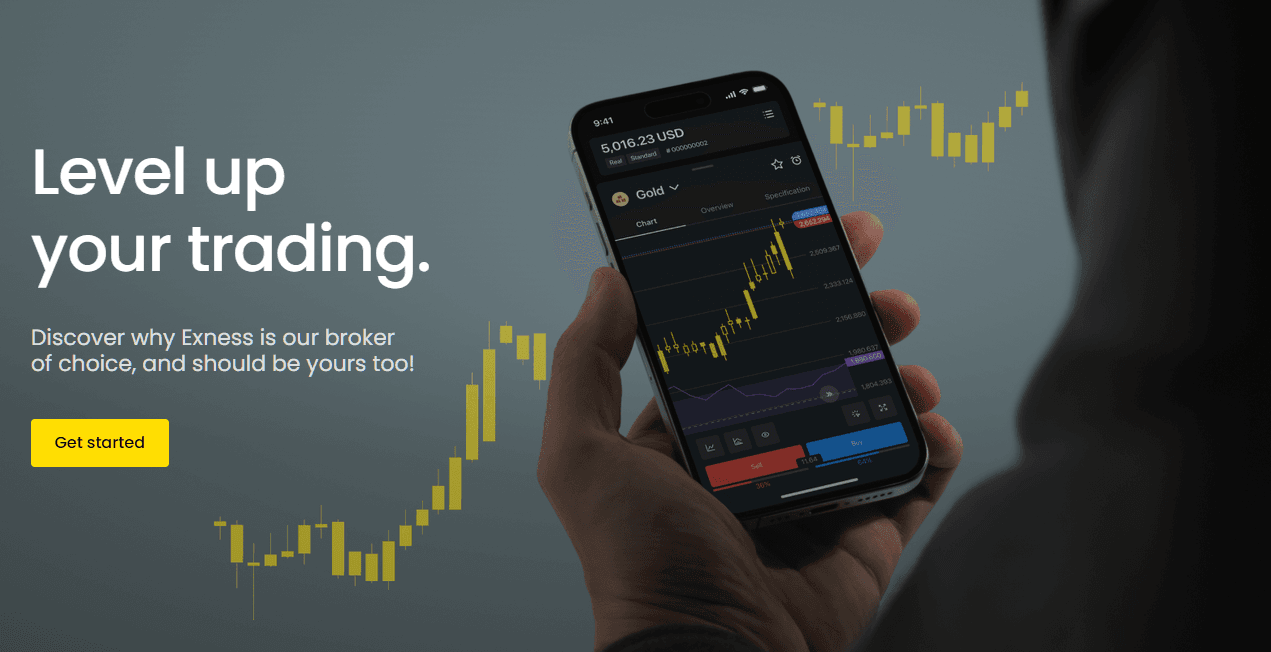
Exness is well known for offering Unlimited Leverage, one of its most distinctive trading features.
However, Unlimited Leverage does not mean you can use unlimited leverage at all times or on every instrument.
Your available leverage depends on factors such as account Equity, Unlimited Leverage eligibility, the trading instrument, and temporary Higher Margin Requirements (HMR).
| Account / Trading Condition | Maximum Available Leverage |
|---|---|
| Equity below $5,000 + Unlimited criteria met | Unlimited |
| Equity below $5,000 without Unlimited Leverage | 1:2,000 |
| Equity $5,000–$29,999.99 | 1:2,000 |
| Equity $30,000–$99,999.99 | 1:1,000 |
| Equity $100,000+ | 1:500 |
| Eligible Forex pairs | Up to Unlimited |
| Gold & Silver | Up to Unlimited |
| Other instruments | Instrument-specific margin requirements |
For real trading accounts, Exness currently requires Equity below $5,000, at least 10 closed orders, and a minimum total trading volume of 5 lots or 500 cent lots across real trading accounts in the Personal Area to qualify for Unlimited Leverage.
- What Is Leverage in Forex Trading?
- What Is Exness Unlimited Leverage?
- Does Exness Always Allow Unlimited Leverage?
- When Does Exness Reduce Leverage?
- Does Lot Size Determine Your Exness Leverage?
- How Should You Use High Leverage?
- Is High Leverage Dangerous?
- What Is Negative Balance Protection?
- Exness Leverage FAQ
- Is Exness Unlimited Leverage really unlimited?
- What are the requirements for Unlimited Leverage?
- What happens if my Equity exceeds ,000?
- Can I use Unlimited Leverage for Gold?
- Does Exness reduce leverage during NFP and other major news?
- Does Exness reduce leverage during weekends?
- Is higher leverage always better?
- Should You Open an Exness Account?
- Final Takeaway
What Is Leverage in Forex Trading?
Leverage allows traders to control a larger trading position with a smaller amount of Margin.
For example, with 1:100 leverage, a $100,000 position may require approximately $1,000 of Margin under a standard variable-margin calculation.
The basic relationship is:
Higher leverage → Lower Margin requirement
This is the main advantage of high leverage.
However, leverage does not guarantee higher profits.
If the market moves in your favor, a larger position can generate a larger profit. If the market moves against you, losses can also increase quickly.
For beginners, the most important distinction is:
Leverage affects the Margin you need, while Position Size determines your actual market exposure.
A trader using 1:2,000 leverage with a small position can potentially take less risk than a trader using 1:100 leverage with an oversized position.
Exness itself warns that higher leverage can increase both potential profits and potential losses.
What Is Exness Unlimited Leverage?
Unlimited Leverage is the highest leverage setting offered by Exness.
But “Unlimited” does not mean:
- unlimited profit,
- unlimited position size,
- unlimited leverage on every instrument, or
- unlimited leverage under every market condition.
Instead, it allows eligible traders to use extremely high leverage, resulting in a very low Margin requirement for supported positions.
Unlimited Leverage Requirements
For real trading accounts, Exness currently requires:
- Equity below $5,000
- At least 10 closed orders, excluding pending orders
- At least 5 lots or 500 cent lots of trading volume across real accounts in the Personal Area
Once these criteria are met, the Unlimited Leverage option becomes available for eligible trading accounts.
Unlimited Leverage is currently available for:
- Major Forex pairs
- Minor/Cross Forex pairs
- Gold (XAU)
- Silver (XAG)
It is not available for instruments such as Exotic currency pairs, Cryptocurrencies, Energies, Stocks, Indices, XPD and XPT, which use fixed margin requirements.
Therefore, if you are considering Exness because of Unlimited Leverage, always check whether the instrument you want to trade is actually eligible.
Does Exness Always Allow Unlimited Leverage?
No.
This is one of the most important points to understand.
Even if your account qualifies for Unlimited Leverage, your maximum available leverage can change when your account Equity increases.
| Account Equity | Maximum Available Leverage |
|---|---|
| $0–$4,999.99 | Unlimited if eligible |
| $5,000–$29,999.99 | 1:2,000 |
| $30,000–$99,999.99 | 1:1,000 |
| $100,000+ | 1:500 |
If your Equity increases above $5,000, Unlimited Leverage is no longer available and the maximum becomes 1:2,000. At higher Equity levels, the maximum leverage decreases further.
Unlimited Leverage is a conditional feature, not a permanent guarantee.
When Does Exness Reduce Leverage?
Exness can also increase Margin requirements during periods of elevated market risk through Higher Margin Requirements (HMR).
When HMR applies, more Margin is required to open affected positions, effectively reducing the leverage available during that period.
| Trigger | Effect | Typical Rule |
|---|---|---|
| Equity increases | Maximum account leverage decreases | 1:2,000 → 1:1,000 → 1:500 |
| Major economic news | HMR increases Margin | New positions may be capped |
| Weekend market closure | HMR increases Margin | About 3 hours before / 1 hour after |
| Daily market breaks | HMR may apply | Instrument-specific |
| Fixed-margin instruments | Account leverage may not change Margin | Instrument-specific |
Major Economic News
For most instruments, positions opened from 15 minutes before until 90 seconds after a high-impact economic news release can be subject to HMR.
Examples include:
- Non-Farm Payrolls (NFP)
- US CPI
- FOMC decisions
- Major central-bank announcements
During HMR, the leverage applicable to affected instruments is capped according to Exness’s rules.
Therefore, even if your account has Unlimited Leverage, you should never assume that Unlimited Leverage remains available during major news releases.
Weekend and Market Closures
For most instruments, HMR generally applies from around 3 hours before the weekend market close until 1 hour after the market reopens.
BTC and ETH are exceptions to weekend-closure HMR because they trade continuously.
If you hold positions over the weekend, it is therefore important to maintain sufficient Free Margin and consider the possibility of price gaps.
Does Lot Size Determine Your Exness Leverage?
Not through one simple rule such as “X lots automatically means Y leverage.”
Exness uses different Margin calculation methods depending on the instrument.
Dynamic Margin Requirements
With dynamic Margin Requirements:
Higher leverage = Less Margin required
Margin requirements can change based on factors including account Equity, major economic news and market closures.
Fixed Margin Requirements
Some instruments use fixed Margin Requirements.
These include certain:
- Exotic currency pairs
- Cryptocurrencies
- Energies and some metals
- Stocks
- Indices
For these instruments, increasing your account leverage—including Unlimited Leverage—does not necessarily reduce the Margin required.
This is why you should always check the actual Margin shown by your Exness trading platform before opening a position.
How Should You Use High Leverage?
For me, the biggest advantage of high leverage is capital efficiency, not taking bigger risks.
Suppose you have $1,000 in your account.
With lower leverage, more capital may be locked as Margin.
With higher leverage, the same position may require less Margin, leaving more Free Margin available for other trades or risk management.
Forex
For major currency pairs such as EUR/USD and GBP/USD, I prefer using high leverage to reduce unnecessary Margin requirements rather than automatically increasing my Lot Size.
Gold
Gold can be considerably more volatile than major Forex pairs.
Even when Unlimited Leverage is available, I would focus on controlling Position Size and using an appropriate Stop Loss rather than increasing exposure.
Major Economic News
Before NFP, CPI or major central-bank decisions, I avoid oversized positions.
High volatility and HMR can occur at the same time, creating additional risks for new positions.
Weekend Trading
If I plan to hold a position over the weekend, I check my Free Margin first and consider the possibility of a market gap when trading resumes.
My basic rule is:
Use leverage to improve capital efficiency—not to justify excessive exposure.
Is High Leverage Dangerous?
High leverage itself is not necessarily the problem.
The bigger problem is using it to open positions that are too large for your account.
Consider two traders.
Trader A
- Uses high leverage
- Risks approximately 1% per trade
- Uses Stop Loss
- Controls Position Size
Trader B
- Uses 1:100 leverage
- Opens a very large position
- Does not use Stop Loss
- Adds to losing positions
Trader B could have significantly greater actual risk despite using lower leverage.
For beginners, I would therefore prioritize:
- Position Size
- Risk per Trade
- Stop Loss
- Free Margin
- Money Management
before trying to maximize leverage.
What Is Negative Balance Protection?
Negative Balance Protection (NBP) is another useful safety feature when trading with leverage.
If a Stop Out causes an eligible Exness trading account to have a negative balance, the NBP system can reset the negative balance to zero, meaning the negative portion is compensated rather than becoming an additional debt.
For example, if a $100 account reaches a -$50 balance after Stop Out, NBP can reset the balance to $0.
However, NBP does not reimburse normal trading losses. If you lose $300 from a $1,000 account, that $300 is still your trading loss.
For a detailed explanation of how NBP works, see our dedicated guide:


NBP is an additional safety mechanism—not a replacement for Stop Loss, Position Sizing or Risk Management.
At this point, you should understand the most important fact about Exness:
Unlimited Leverage exists, but it is conditional.
If you want to check your available leverage and the trading conditions applicable to your account:
If you are new to leveraged trading, consider starting with a Demo Account to learn how Margin, Free Margin and Stop Loss work before trading real funds.
Exness Leverage FAQ
Is Exness Unlimited Leverage really unlimited?
Unlimited Leverage is Exness’s highest leverage setting, but it is subject to eligibility requirements, supported instruments, HMR periods and applicable regulatory restrictions.
What are the requirements for Unlimited Leverage?
For real accounts, Equity must be below $5,000, with at least 10 closed orders and a minimum total trading volume of 5 lots or 500 cent lots across real trading accounts in the Personal Area.
What happens if my Equity exceeds $5,000?
Unlimited Leverage is no longer available. The maximum leverage becomes 1:2,000, then decreases to 1:1,000 and 1:500 as Equity reaches higher levels.
Can I use Unlimited Leverage for Gold?
Yes. Gold and Silver are currently among the instruments eligible for Unlimited Leverage when the account meets the requirements. However, HMR can still temporarily restrict leverage.
Does Exness reduce leverage during NFP and other major news?
Yes. HMR can apply to new positions around high-impact economic releases. For most instruments, the HMR period covers positions opened from 15 minutes before until 90 seconds after the news release.
Does Exness reduce leverage during weekends?
For most instruments, HMR applies around weekend market closures, generally from approximately 3 hours before the close until 1 hour after reopening.
Is higher leverage always better?
No. Higher leverage mainly reduces the Margin required to open a position. Your actual risk depends much more on Position Size, Stop Loss and total market exposure.
Should You Open an Exness Account?
If you are considering Exness because of Unlimited Leverage, there are three points to remember.
First, Exness does offer Unlimited Leverage.
Eligible accounts can use it on supported Forex and precious-metal instruments.
Second, Unlimited Leverage is not always available.
Your Equity, trading instrument, major economic news, market closures and Margin requirements can affect the leverage available at the time you trade.
Third, high leverage should be used for flexibility and capital efficiency—not to take uncontrolled risks.
As a beginner, you do not need to use the maximum leverage simply because it is available.
The real advantage is having more flexibility in how you allocate your trading capital.
New to Forex trading? Start with a Demo Account, learn how leverage and Margin work, and develop your risk-management rules before trading with real money.
Final Takeaway
Exness stands out because eligible traders can access Unlimited Leverage on supported instruments.
But the most important question is not simply:
“How high is Exness leverage?”
It is:
“When can I use it, and when will it be restricted?”
Your available leverage and Margin requirements can be affected by:
- Account Equity
- Unlimited Leverage eligibility
- Trading instrument
- Major economic news
- Weekend and market closures
- Fixed Margin Requirements
- Applicable regulations
For beginners, remember one simple principle:
Leverage determines how much Margin you need. Position Size determines how much market exposure you take.
Used responsibly, Exness’s high leverage can be a useful capital-efficiency tool rather than simply a way to take larger risks.
Before opening a real position, always check the latest leverage and Margin requirements displayed in your Exness Personal Area or trading platform, because the applicable conditions can vary according to your account, instrument and market conditions.